Digital dentistry is changing how dental labs design and manufacture restorations. Digital scanning, CAD design, and additive manufacturing allow labs to move from traditional fabrication toward more standardized digital workflows.
Metal 3D printing is one of the most practical parts of this transition. It reads digital design files directly and melts metal powder layer by layer. Wax patterns and casting are eliminated.
Read on for more about dental metal 3D printers, their applications, and advantages.
What is Dental Metal 3D Printing?
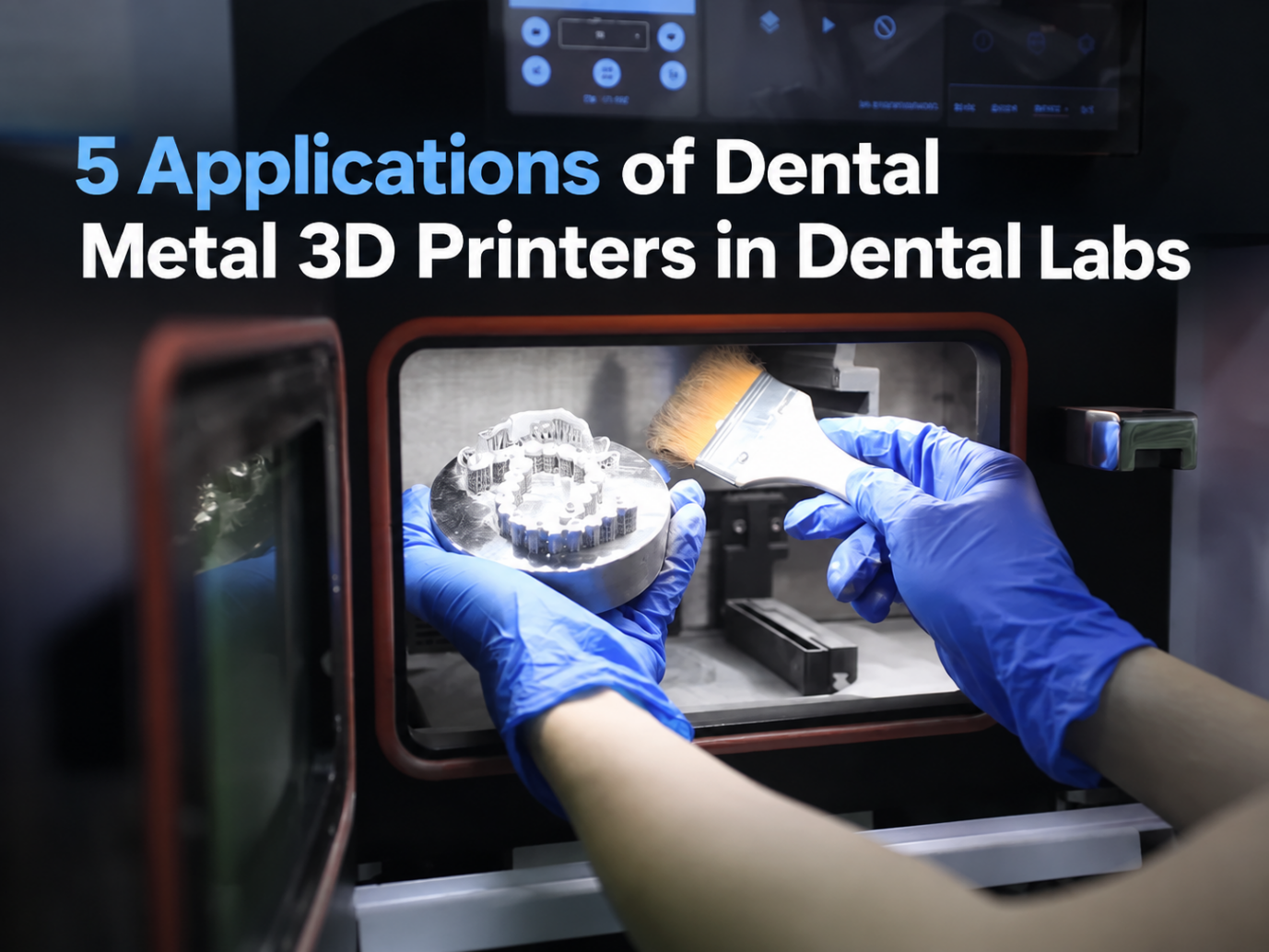
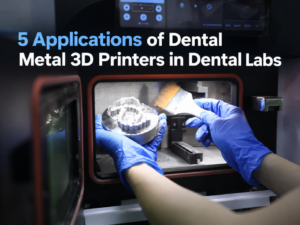
Dental metal 3D printing is an additive process that builds restorations by stacking metal powder layer by layer. A dental metal 3D printer reads CAD files, slices the 3D model into thin layers, and melts metal material layer by layer to form a dense part.
1. Common technologies
- Selective Laser Melting (SLM) is the mainstream technology in dental metal restorations. It uses a high-power fiber laser to melt metal powder in an inert gas environment. Parts have high density and stable mechanical properties.
- Direct metal laser sintering (DMLS) operates on a similar principle, but with relatively lower laser energy density, where metal powder particles are bonded through sintering rather than complete melting.
The core components of a metal laser 3D printer are the laser source and scanning system. Layer thickness typically ranges from 20 to 60 microns, such as Riton Metal 3D Printer MLAB.
2. Common materials
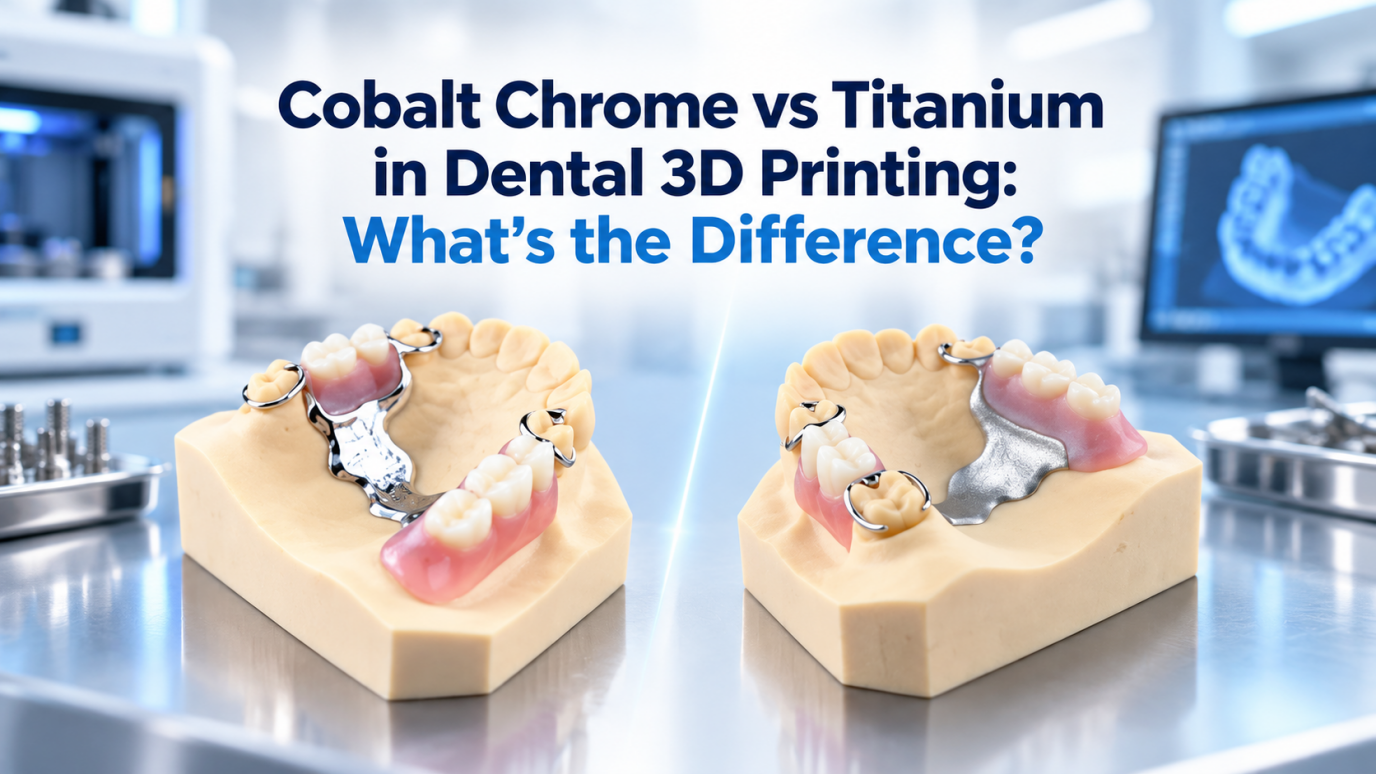
- Cobalt-Chromium (CoCr): The most used material in dental metal printing. CoCr offers high hardness, wear resistance, and corrosion resistance. It is the standard material for crowns, bridges, and frameworks.
- Titanium: Valued for its outstanding biocompatibility, high strength-to-weight ratio, and resistance to corrosion in the oral environment. Titanium is the preferred material for dental implants.
- Nickel-Chromium (NiCr): A cost-effective alternative to CoCr. NiCr alloys provide adequate strength for certain prosthetic applications.
5 Applications of Dental Metal 3D Printers in Dental Labs
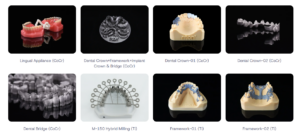
A dental metal 3D printer handles a wide range of prosthetic and restorative work, including:
1. Metal Crowns
Metal crowns are the most basic application of dental metal 3D printing. Traditional processes require wax-up and casting. There are many steps and long cycles.
A metal laser 3D printer prints cobalt-chromium crowns directly. Casting is eliminated, thus greatly reducing shrinkage and deformation risks.
2. Metal Bridges
Dental bridges replace one or more missing teeth by anchoring to adjacent natural teeth or implants. The metal framework of a bridge must be rigid enough to span the gap while fitting each abutment tooth with precision.
The advantage of metal 3D printing is geometric consistency between the design file and the final part. The digital workflow passes scan and design data directly to the printer. Manual error is also reduced.
3. Dental Implants
Dental implants are titanium posts surgically placed into the jawbone to serve as artificial tooth roots. The success of an implant depends on osseointegration.
A dental metal 3D printer enables individualized and precised implants production.
Medical metal printing with titanium alloys produces implants with mechanical strength and biocompatibility. Custom implant abutments are also fabricated using the same process.
4. Removable Partial Denture Frameworks
Removable partial dentures (RPDs) restore function and appearance for patients missing several teeth. The metal framework of an RPD includes clasps, rests, and major connectors. All of which must be thin, strong, and precisely adapted to patients’ teeth and soft tissue.
RPD frameworks are complex. Traditional casting of these frameworks is time-consuming and prone to distortion. A metal desktop 3D printer handles this complexity with ease.
5. Orthodontic Frameworks
Metal frameworks for orthodontic appliances, including lingual retainers, palatal expanders, and custom bracket bases, require precise fit and consistent spring properties.
A dental metal 3D printer produces orthodontic frameworks directly from digital treatment plans. The digital workflow eliminates the need for physical impressions and stone models. Each framework is built to the exact specifications defined by the dentists.
Why Do Dental Labs Use Metal 3D Printing?
- Improve clinical efficiency: Metal 3D printing removes casting from the workflow. After design is complete, printing starts directly. Time for wax-up, investment, melting, cooling, and casting bur removal is eliminated.
- Enhance patient experience: Digital workflows reduce reliance on traditional impressions. Intraoral scanning replaces silicone impressions, which improves patient comfort and restoration seating precision.
- High precision: SLM layer thickness is controlled at 20 to 60 μm. Direct metal printing eliminates shrinkage and deformation variables from casting. The gap between framework and model falls within clinically acceptable ranges.
- Cost-effectiveness for small-batch production: One metal desktop 3D printer can print crowns, frameworks, and bridges from different cases simultaneously, offering high powder utilization and low material waste.
- Design flexibility: Additive manufacturing is not limited by traditional process geometry. Thin structures and gradient thickness are simple in 3D printing. Technicians can optimize framework design for a patient’s specific anatomy.
Riton Dental Metal 3D Printers
Riton has over 29 years of laser equipment experience, having developed and launched China’s first metal 3D printer dedicated to dental restoration “D-280.”
- Riton MLAB: A metal desktop 3D printer built for small to mid-volume labs. The MLAB features a 250-watt laser power, a melting area of 100×90 mm, and 20-60μm layer thickness. It can print up to 100 crowns or 7 frameworks in approximately 2.5 hours.
- Riton M-150 Series: Designed for medium-volume production. The M-150 provides a larger melting area (150×140 mm) and prints up to 200 crowns or 17 frameworks in 4.5 hours.
- Riton M-200D: A dual-laser, high-capacity system for large dental labs or centralized production centers. The M-200D prints up to 430 crowns or 35 partial frameworks in 5.5 hours, making it one of the most productive dental metal 3D printers on the market.
Riton also offers metal printing materials, including CoCr, titanium, and NiCr alloy powders. For more information and pricing, contact Riton now.