Quick Picks
- Riton RXDent-D130
- Sprintray Pro 2
- Formlabs Form 4B
- Asiga Max 2
- Stratasys J5 DentaJet
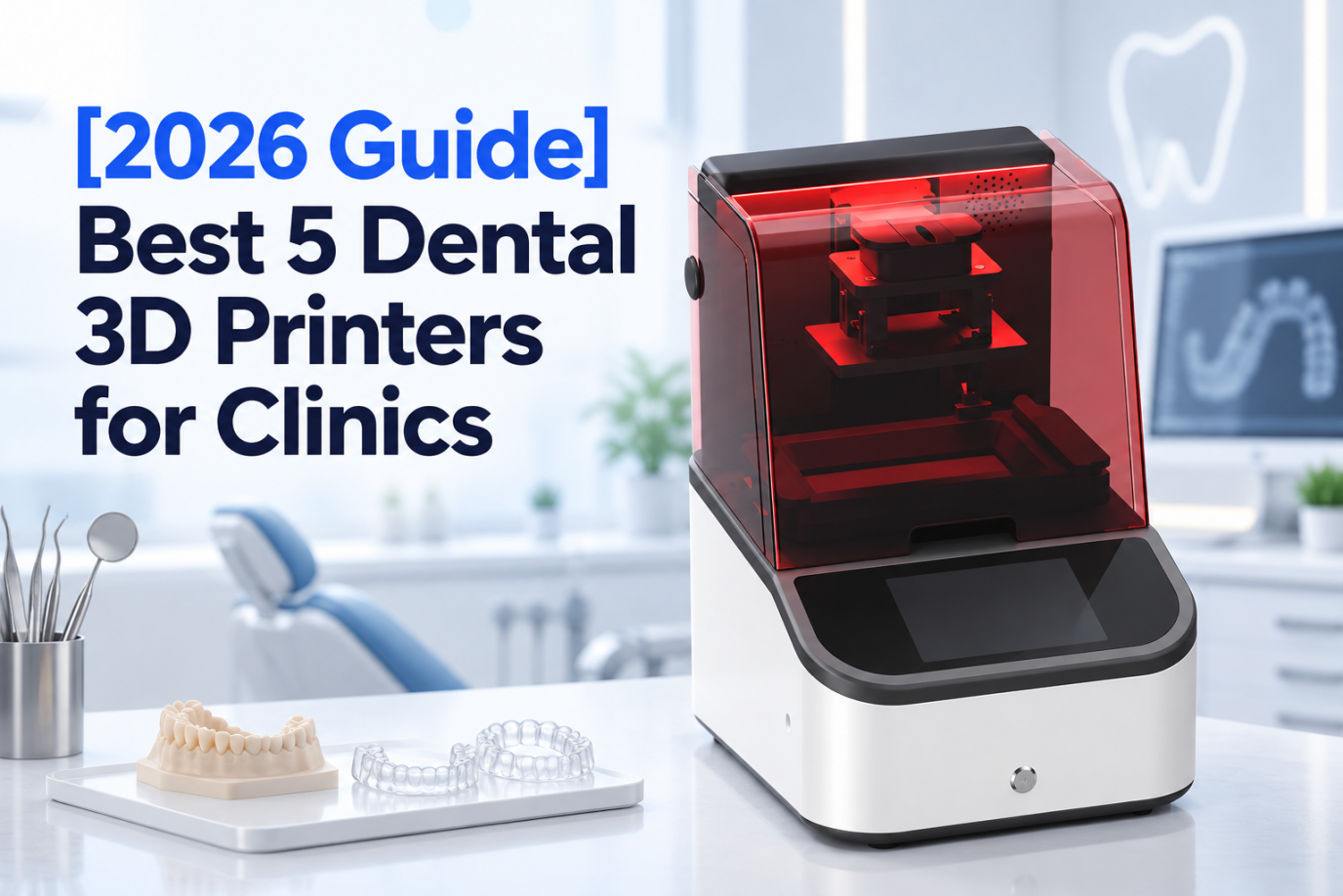
Dental 3D printers are additive manufacturing devices specifically used to fabricate dental restorations, models, guides, and other dental applications. They convert CAD designs into physical parts by curing photosensitive resin or other materials layer by layer.
Currently, the 3D printers for dentistry on the market mainly adopt DLP, LCD, SLA, MSLA, and PolyJet technologies. When choosing a 3D printer for your clinic, you need to comprehensively consider accuracy, speed, material ecosystem, software workflow, etc. Based on product performance, this article selects five best dental 3D printers worth considering in 2026.
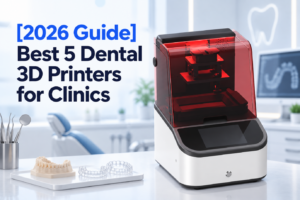
Compare the Best 5 Dental 3D Printers in 2026
Dental 3D Printer | Technology | الدقة | Key Features |
Riton RXDent-D130 | DLP | 30μm | One-touch operation, automatic calibration, dual resin tanks, auto-resin refill, long-lifetime light source, dual heating system, designed for dental applications. |
SprintRay Pro 2 | DLP (Optical Panel™ technology) | 35μm | Built for dental workflows with high throughput; supports 15+ dental applications; features 6+ full arches printing once. |
Formlabs Form 4B | MSLA | 50μm | Provides fast resin printing, open material mode, and support for various clinical and laboratory applications. |
Asiga Max 2 | DLP | 50μm/62μm | Open material system with broad resin compatibility; wide applications. |
Stratasys J5 DentaJet | PolyJet | 18μm (layer) | Supports multi-material and full-color printing; can print up to five materials simultaneously; designed for advanced dental lab production. |
Riton RXDent-D130
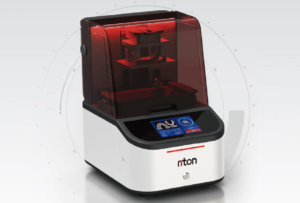
The Riton RXDent-D130 is a resin dental 3D printer using DLP technology. Its build size is 130×70×120mm (large vat) and 60×60×120mm (small vat), with a resolution of 1920×1080 pixels and 30μm accuracy.
The light source wavelength is 385nm, printing dental parts per layer in 1-6 s, with an adjustable layer thickness between 0.01-0.2mm. It features a 7-inch HD touchscreen, supports wireless and USB printing, and weighs only 20kg.
From the specifications, the Riton RXDent-D130’s positioning is clear: it offers clinics a compact chairside printing solution with high accuracy.
Pros
- 30μm accuracy, sufficient for guides, models, temporary crowns, bridges and more appliances.
- P-class ball screw and closed-loop motor maintain precise Z-axis repeatability.
- The 385nm wavelength is compatible with most dental resin brands, keeping material options open.
- An auto-calibration module for light intensity and uniformity, ensuring less than ±3% deviation and over 95% uniformity across the build platform.
- The integrated dual heaters reach 45°C in five minutes, ensuring consistent polymerization even for high-viscosity resins.
- The dual-vat system reduces resin waste during small-batch printing, ideal for on-demand chairside production.
- Automated liquid resin refilling system reduces manual operation.
- Trackspeeling force in real time and monitors release film lifespan to prevent equipment damage and reduce print failure rates.
Cons
Clinics with large-scale production requirements may need multiple units.
Sprintray Pro 2
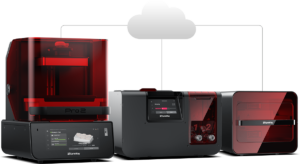
The SprintRay Pro 2 is a high-throughput DLP dental 3D printer. It features patent-pending Optical Panel technology, 35μm resolution, and a 385nm UV-A LED light source. The standard kit can print six or more arches at once, and speed increases further with the Arch Kit.
Pro 2’s core advantage is not a single hardware spec, but the complete chain SprintRay has built: from AI design, cloud platform management, to post-processing equipment.
It supports over 15 dental indications, including night guards, temporary crowns, orthodontic models, surgical guides, and removable dentures. The 12-inch touchscreen improves operational efficiency.
Pros
- Optical Panel technology eliminates traditional DLP distortion and maintains35μm accuracy across the full build area.
- The 385nm UV-A wavelength and liquid-cooled LED design leave room for future biomaterial innovation.
- Optional Arch Kit doubles vertical print speeds for orthodontic models.
- RFID tags on resin tanks track material usage.
- Direct integration with SprintRay Cloud enables one-click nesting and automated file error repairs.
Cons
- Pricing is high among peers.
- Closed ecosystem needs SprintRay resins.
Formlabs Form 4B
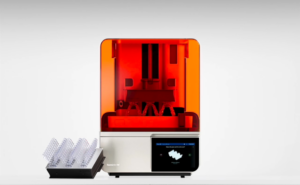
Formlabs Form 4B is an MSLA (masked stereolithography) 3D printer for dental office use. It uses Formlabs’ Low Force Display™ (LFD) print engine, with a pixel size of 50μm.
Form 4B supports 38 Formlabs materials, 15 of which are biocompatible, and also accommodates third-party resins through Open Material Mode.
Its layer thickness ranges from 25-200μm and supports automatic support generation with touch-point removal. It offers a build volume of 20.0 × 12.5 × 21.0 cm and operates at a maximum print speed of 100 mm/h.
Pros
- Supports38 Formlabs materials; 15 biocompatible materials cover the full range from temporary crowns, bridges, surgical guides, to splints and models.
- Open Material Mode breaks closed-system limits, allowing third-party resins and more controllable long-term consumable costs.
- User-friendly software reduces the learning curve for dental teams.
- Automatic support generation and touch-point removal reduce post-processing time.
Cons
- 50μm pixel size falls short of DLP competitors at 30-35μm.
- Pricing is relatively high among peers.
Asiga Max 2
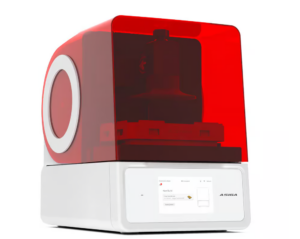
The Asiga Max 2 is an industrial-grade DLP dental 3D printer. It uses a 385nm UV LED, available in two configurations: Max 2 (50) with 50μm pixel size and 96×54×76mm build size, and Max 2 (62) with 62μm pixel size and 119×67×75mm build size.
The core differentiator is the Smart Positioning System (SPS), which uses active layer monitoring to ensure precise thickness control on every layer.
The Max 2 features a self-calibrating UV LED and integrated radiometer, ensuring long-term print consistency. A chamber heating system supports pre-heating of temperature-sensitive materials, reducing resin viscosity for faster printing.
Pros
- SPS active layer monitoring verifies every layer and reducesthe risk of whole-batch print failures.
- Self-calibrating light source and industrial-grade LEDs mean minimal performance degradation over years of use.
- Transparent Mode prints truly transparent resin without fogging or brittleness.
- UltraGLOSS model eliminatesthe need for manual polishing.
Cons
- Build size is the smallest of the five, limiting high-volume production.
- 50μm and 62μm pixel size falls short of competitors.
Stratasys J5 DentaJet
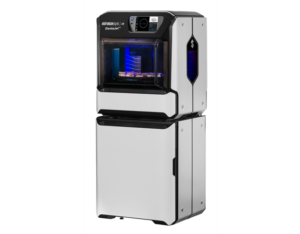
The Stratasys J5 DentaJet is a PolyJet-based dental 3D printer for labs. PolyJet jets photopolymer droplets and cures them instantly with UV light, allowing the J5 DentaJet to use multiple materials and colors simultaneously. Layer thickness can go down to 18μm, the print tray area is 1,174 cm², and the maximum part size is 140×200×190mm.
The J5 DentaJet material system includes rigid, flexible, clear, and color biocompatible resins. It supports mixed tray printing, outputting parts in different materials and colors in a single job.
Pros
- PolyJet’s unique full-color multi-material capability produces models with realistic gingival color and anatomical detail, valuable for patient communication and implant planning.
- 18μm layer thickness allows for outstanding surface quality and detail reproduction on complex anatomy.
- Mixed tray printing reduces batch management complexity, covering multiple indications and material needs in one job.
- Suitable for large clinics and dental lab 3D printing.
Cons
- Device size and weight mean it can only sit in a fixed lab location, not chairside.
- Higher equipment costs.
How to Choose the Right Dental 3D Printer?
The five dental 3D printers listed above are all validated choices, but every clinic has different needs. Use the following dimensions to determine which features you actually require.
- Printing Technology: DLP is fast and accurate. MSLA costs less for high-volume production. PolyJet enables full-color multi-material printing.
- Printing Accuracy: Higher accuracy can help improve fitting quality and reduce manual adjustments after printing.
- Printing Speed: Choose the equipment with a printing speed of 1-6 s/layer or 50mm/hour if your clinics pursue same-day delivery.
- Material Compatibility: Closed systems are plug-and-play but limit resin choice. Open systems offer more options and better cost flexibility.
- Automation & Ease of Use: Auto calibration, one-click printing, auto-resin fill, and a large screen provide convenience and cut training time and errors.
- Software Integration: A 3D printer for dental office use must connect smoothly with your scanner, CAD software, and post-processing tools.
Final Verdict
The best dental 3D printer depends on the specific needs of each clinic or laboratory.
If you want high-precision, stable, and powerful equipment, the Riton RXDent-D130 provides a solid foundation. For practices demanding extreme reliability and fast output speed, the Formlabs Form 4B is worth consideration. If your daily priority is absolute material freedom, the Asiga Max 2 is a strong option. Finally, for high-volume labs requiring full-color, multi-material trays, the Stratasys J5 DentaJet capability has no substitute.
FAQs
1. Should I choose a DLP or LCD 3D printer?
DLP and LCD are both photopolymerization technologies; the core difference is the light source. DLP uses a projector to cast an entire layer image onto the resin surface, while LCD uses a liquid crystal screen as a mask.
DLP typically has smaller pixel sizes and longer light source life, but higher equipment cost. LCD has a lower initial cost, but the LCD screen is a consumable whose long-term replacement cost must be factored in.
2. Can dental 3D printers print crowns and bridges?
Yes, but dental resin 3D printing of “permanent crowns and bridges” is still evolving and being validated. The mainstream applications today are temporary crowns and bridges and diagnostic restorations, using ceramic-filled or temporary restoration resins.
3. Is a dental 3D printer more worthwhile than milling?
The two are complementary, not substitutes. Milling machines remain irreplaceable for permanent zirconia and ceramic restorations. 3D printers are lower-cost and faster for models, guides, temporary restorations, and splints.