When selecting a wire-bending method for a dental laboratory, the decision essentially comes down to two distinct manufacturing philosophies. While manual forming grants technicians hands-on precision for every adjustment, automated forming relies on pre-programmed sequences to consistently replicate exact geometries. Ultimately, the right choice hinges on whether your laboratory prioritizes dynamic adaptability or high-volume repeatability.
A dental wire bending machine becomes particularly relevant when wire forming is no longer an occasional technical task. Once case volume rises, repeated manual adjustments can become a significant part of production time. Automation changes that equation by shifting repetitive forming work from the technician to controlled machine movements.
Manual or Automated: Where Does the Difference Actually Matter?
Speed is an obvious difference, but it is not the most useful one. A faster process has little value if the resulting wire still requires substantial correction. For dental production, consistency between cases can matter just as much as the time required to produce an individual component.
Manual bending relies on technician judgment. Wire positioning, force, angles, and corrections are performed directly by the operator. Skilled technicians can adapt quickly, but the outcome remains influenced by individual technique.
Automated forming approaches the same task through programmed motion. Our WBM-V2 specifies bending repeatability of ±0.5° and feeding accuracy of ±0.05 mm. Its compatible orthodontic steel wire diameter is 0.5–1.0 mm.
That distinction makes the comparison more precise: manual bending prioritizes hands-on adaptability, while automated bending prioritizes controlled repetition.
For Low-Volume Work, Is Manual Bending Still the Better Choice?
A laboratory with limited wire-forming demand may not gain enough from automation to justify changing its production method. If technicians produce only a small number of appliances and each case requires individual adjustments, manual work can remain efficient.
Manual production also has an inherent advantage when the required geometry changes unexpectedly. A technician can inspect the wire, make an adjustment, and continue without modifying a digital program or production sequence.
Capital expenditure is another practical issue. Purchasing automated equipment involves more than the machine itself. Training, workflow integration, maintenance, and production planning all become part of the investment decision.
For that reason, we would not recommend automation simply because it is technologically newer. A wire bending machine supplier should first understand the laboratory’s actual production volume, appliance mix, and current labor requirements.
If manual bending is already fast enough and correction rates are low, retaining the existing process may be commercially sensible. Automation becomes more compelling when repetition itself has become a production constraint.
Does Automation Deliver Better Consistency at Production Scale?
The case for automation becomes stronger as the same forming tasks are repeated. Our WBM-V2 uses programmable logic controller (PLC) and multi-axis servo control, with six-axis coordinated motion for wire forming. Its stated bending speed reaches up to 200°/s.
Production examples are also significant. We state that standard structural components can be completed in less than 60 seconds, with overall efficiency stated at under 15 minutes per device. These figures provide reference points for evaluating automated production, rather than guarantees of every laboratory’s actual cycle time.
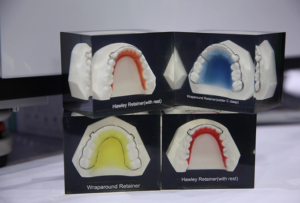
The equipment is designed for automated orthodontic steel wire bending across several appliance types. Listed examples include Hawley retainers, Begg retainers, lingual bars, removable partial denture clasps, space maintainers, Nance appliances, tongue shields, Frankel appliances, and lingual arches.
That breadth matters for a laboratory handling recurring appliance orders. Instead of repeatedly reproducing similar shapes by hand, programmed forming can establish a more standardized manufacturing process.
The manufacturer also states that the system reduces labor input by 70%. We would treat that figure as a published performance claim requiring comparison with the laboratory’s own staffing and workflow data, rather than assuming an identical saving in every environment.
When Does Digital Wire Bending Become Worth the Investment?
Automation becomes more strategically valuable when wire bending is connected to digital design rather than treated as an isolated production step.
Our WBM-V2 connects with Riton Cloud and OrthoWireLab. Design data can be sent directly to the equipment, while the software environment supports order tracking and management. Remote start and stop functions are also provided.
This changes the workflow fundamentally. Instead of a technician interpreting a physical or digital design and manually reproducing its geometry, production data can move from digital planning toward machine-controlled forming.
OrthoWireLab also includes AI-assisted design functions. The published information describes path algorithms for personalized archwire shapes and 3D dynamic calculation for path planning and interference avoidance.
For laboratories already investing in digital orthodontic workflows, this connectivity can make automated bending more attractive. A wire bending machine supplier should therefore be assessed not only on mechanical specifications but also on how effectively the equipment fits the laboratory’s existing digital process.
Which Dental Wire Bending Method Should a Lab Choose?
There is no universal winner. Manual bending is better suited to low-volume production, unusual cases, and workflows where technicians need immediate hands-on control. It can remain a rational choice when investment in automation would exceed the value created by higher throughput or consistency.
Automated production has a clearer advantage when the laboratory repeatedly produces standardized wire components. Machine-controlled forming can reduce dependence on repetitive manual movements while providing defined feeding and bending parameters.
Our view is that the decision should start with production evidence. Measure how many hours technicians spend bending wire, how often completed wires require correction, and how much demand the laboratory expects to handle.
A dental wire bending machine is therefore not automatically “better” than manual work. It becomes the better choice when recurring production volume, consistency requirements, and digital workflow integration make automation economically and operationally meaningful.
At that point, working with a wire bending machine supplier requires laboratories to evaluate the comprehensive production system rather than a standalone device. The right selection matches the lab’s actual operational demands while offering technicians appropriate control.