Increasing production volume changes the way dental laboratories approach polishing. A method that works for occasional cases may become difficult to manage as laboratories process larger volumes of dental components.
The challenge is not only completing polishing faster. Production teams also need consistent surface finishing, controlled workflows, and reduced dependence on manual operations.
To make an informed choice on a plasma polishing machine, laboratories must evaluate production objectives, material specifications, and workflow integration rather than looking at the equipment in isolation.
Dedicated to empowering efficient digital manufacturing, we at Riton design innovative dental production technologies. Our RT-900 plasma polishing machine provides laboratories with an advanced solution for surface optimization.
Why High-Volume Dental Production Requires a Different Polishing Approach
Manual polishing remains common in many dental laboratories, but increasing output creates new challenges. Each restoration may require technician involvement, and differences in operator technique can affect finishing consistency.
For laboratories producing digitally manufactured metal dental components, post-processing becomes an important production stage. A stable polishing process helps maintain predictable results after printing.
High-volume environments require equipment that supports repeatable operation. Instead of relying entirely on individual polishing skills, laboratories can introduce automated solutions that create a more controlled workflow.
A high-volume plasma polishing machine should therefore be evaluated as part of the complete production line. It is not simply a replacement for hand tools. It represents a change in how laboratories manage finishing processes.
The selection process should begin with understanding the laboratory’s current workflow problems. Production volume, finishing requirements, and technician workload all influence which equipment approach is suitable.
What Buyers Should Evaluate Before Choosing a Plasma Polishing Machine
The first question buyers should ask is whether the equipment matches their actual production requirements. A machine designed for industrial-level output may not provide value if the laboratory does not need that capacity.
Workflow integration is another important factor. Dental laboratories should consider how the polishing equipment connects with existing manufacturing steps, including printing, cleaning, and final preparation.
Consistency is also essential. A suitable polishing system should help reduce variation between different operators and different production batches.
A 3D print polisher must also fit the materials being processed. Dental laboratories working with printed metal components should confirm that the equipment is suitable for the alloys used in their production. The RT-900, for example, is specified for CoCr alloy and titanium alloy, with a stated production capacity of 1–4 pieces.
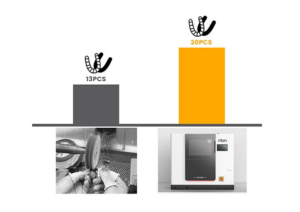
Production efficiency is another useful comparison point. Riton reports that the RT-900 can increase polishing efficiency by approximately 54% compared with traditional manual processing, with a reference example of 13 RPDs per day manually processed versus 20 RPDs using the RT-900. These figures are provided as reference data, so actual output will depend on the production conditions and workflow of each laboratory.
How Automation Changes the Role of Post-Processing in 3D Printing
Digital manufacturing has changed the way dental laboratories organize production. Metal 3D printing can produce complex components efficiently, but printed parts still require cleaning, surface treatment, inspection, and other post-processing steps before they are ready for final use.
Automation brings greater structure to these activities. Instead of relying entirely on manual techniques, laboratories can establish more consistent procedures for repetitive finishing tasks. A modern plasma polishing machine can therefore become an integrated part of the digital manufacturing workflow, helping technicians manage surface treatment in a more controlled and repeatable way.
For dental laboratories, surface treatment can affect both the appearance and usability of printed components. A controlled polishing process makes these requirements easier to manage while reducing unnecessary variation between individual operators or production cycles.
Automation does not eliminate the role of skilled technicians. Their experience remains important for quality assessment, process decisions, and handling applications that require judgment. Equipment can instead take on more standardized production activities, allowing technicians to concentrate on areas where their expertise adds greater value.
This becomes increasingly relevant as laboratories expand their digital production capabilities. As production volumes grow, a structured approach to post-processing can help maintain consistency without placing the entire finishing workload on manual labor.
Where a 3D Print Polisher Fits Into a Dental Laboratory’s Production System
A polishing machine should be considered as part of the production sequence rather than as an isolated piece of equipment. Printing, cleaning, surface treatment, and quality inspection are closely connected, so the performance of one stage can affect the efficiency of the next.
Post-processing can become a bottleneck when printing capacity increases faster than finishing capacity. For laboratories handling higher volumes of metal 3D printed components, a suitable 3D print polisher can help create a more organized transition from printed parts to finished dental components.
When evaluating a polishing solution, buyers should look beyond individual machine functions and consider how it fits their existing production setup. Factors such as restoration types, production volume, operator procedures, finishing requirements, and available workspace can all influence whether a particular system is appropriate.
At Riton, our equipment solutions cover both printing systems and supporting technologies for dental manufacturing workflows. The RT-900 Plasma Polisher is one example of equipment developed for the post-processing stage, alongside other solutions designed to support digital dental production.
Ultimately, the value of a 3D print polisher depends on how well it addresses the laboratory’s actual production requirements. Evaluating the equipment within the context of the complete workflow gives buyers a clearer basis for deciding whether it can improve finishing efficiency, process consistency, and overall production capacity.
Making the Final Equipment Decision for Long-Term Production Needs
Choosing a high-volume polishing system requires more than comparing machine names or individual features. Dental laboratories need to understand their own production challenges first.
A suitable plasma polishing machine should support consistent finishing, fit existing workflows, and provide practical value for daily operations.
The purchasing decision should consider current production requirements as well as future workflow development. Laboratories investing in digital manufacturing equipment need solutions that can support changing production demands.
At Riton, we believe equipment selection should be connected to real laboratory processes. Our goal is to help dental manufacturers create efficient production environments through integrated digital solutions.
A high-volume plasma polishing machine becomes valuable when it solves a specific production challenge. By evaluating workflow needs, material requirements, and operational goals, dental laboratories can make more informed equipment decisions and build stronger manufacturing systems.