Dental laboratories are under increasing pressure to expand digital production without expanding their facilities. Floor space is often limited, particularly for labs operating in established commercial locations.
We therefore need to consider equipment footprint alongside printing capacity, workflow efficiency, and production stability. For us, a small metal 3D printer can provide a practical way to introduce or expand metal additive manufacturing while preserving valuable workspace for other laboratory operations.
Why Footprint Matters in Dental Laboratories
Space planning becomes increasingly important as we add printers, post-processing equipment, material storage, and other production systems. A large machine can consume valuable floor area and restrict how efficiently we arrange the laboratory. We should therefore evaluate the complete equipment footprint rather than considering printing capability alone.
When comparing 3D metal printer companies, we can look for manufacturers that specifically engineer equipment around the realities of dental laboratories. Riton has developed several compact metal 3D printing systems, including the M-150. The company’s history shows a continued focus on smaller dental metal printers, beginning with the D-100 and D-150 and later expanding to the M-150.
M-150 Helps Us Optimize Limited Floor Space
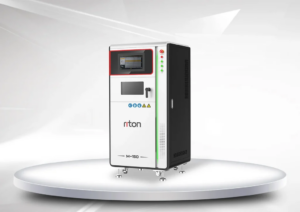
Riton designed the M-150 around the need to combine production capability with a reduced physical footprint. The manufacturer states that the machine occupies approximately 0.8 m², allowing laboratories to adapt it more flexibly to space and site limitations. This makes it particularly relevant when we need to introduce metal printing without redesigning an entire production facility.
The published printer dimensions are 780 × 950 × 1,660 mm, with a weight of 500 kg. The M-150 therefore remains substantial industrial equipment despite its compact positioning. We should account for installation, operator access, gas supply, and related equipment when planning the actual workspace rather than treating the 0.8 m² figure as the total installation requirement.
Small Metal 3D Printer Does Not Mean Low Productivity
One concern we may have when selecting compact equipment is whether a smaller footprint means sacrificing production capacity. For dental labs, that trade-off can undermine the business case if the printer cannot handle our case volume.
The M-150 addresses this concern with a 150 mm × 140 mm melting area, including the build plate, and a layer thickness range of 20–60 μm. The M-150 productivity of up to 200 metal crowns or 17 frameworks in 4.5 hours. Actual production time can vary depending on operating conditions, so we should use these figures for planning rather than treating them as guaranteed cycle times.
Efficient Powder Management Supports More Output
Space efficiency becomes even more valuable when the equipment occupying that space delivers strong production performance. Riton has optimized the M-150’s powder-spreading process with segmented variable speed, dual-cylinder lifting, and pre-powder spreading. These functions are intended to improve the efficiency of the printing process while supporting consistent powder handling.
The M-150’s efficiency increases by at least 30% compared with similar 3D dental equipment. For us, this type of productivity consideration should be evaluated alongside actual case mix, operating schedules, labor availability, and material costs. The goal is not simply to buy a smaller machine, but to maximize production value per unit of laboratory space.
Precision Still Matters When Space Is Tight
A compact printer must still meet the quality requirements of dental production. The M-150 uses a single fiber laser with output power of up to 500W, a maximum scanning speed of 14,000 mm/s, and a 20–60 μm layer thickness range. It supports CoCr alloy and titanium alloy printing.
The machine also incorporates an adjustable optical path system, spot compensation technology, multi-pass contour outlining, island scanning, regional filling, and multiple support structures. These technologies are designed to work together to maintain the precision and quality of printed products.
Stability and Automation Can Improve Workflow Efficiency
For laboratories working within limited space, equipment stability is especially important because production interruptions can disrupt carefully planned workflows. Riton’s M-150 uses a hidden sealed structure for moving components and separates the equipment circuitry from the powder-forming section to support operational stability.
The system also uses automated deoxidation logic and a dual gas supply system. Riton states that this approach reduces gas consumption and reduces waiting time for equipment to refill with gas. We can therefore consider automation not only in terms of convenience but also in relation to how efficiently limited production space is utilized.
Choose the Right Partner for Space-Efficient Growth
Selecting among 3D metal printer companies should involve more than comparing machine dimensions. We need to evaluate footprint, productivity, materials, precision, automation, software, installation requirements, and long-term support as one investment decision.
At Riton, we have focused on dental additive manufacturing for decades, developing China’s first metal 3D printer dedicated to dental restoration in 2016 and subsequently building a broader ecosystem of metal and resin printers, materials, software, and digital dental solutions.
For laboratories with limited facilities, the M-150 demonstrates that compact equipment can still deliver substantial production capacity. Its space-efficient design helps us maximize available floor space while maintaining the flexibility to expand digital dental production. We can make better use of every square meter while continuing to scale digital dental production.