Manual wire bending can become a production bottleneck when an orthodontic laboratory handles increasing numbers of customized appliances. Repeated forming operations demand operator attention, while variations in bending can affect consistency between pieces. An automated system changes the equation by connecting digital design with controlled machine movement.
For laboratories evaluating wire bending machines, the decision should therefore go beyond replacing manual work with automation. The more useful question is what changes across the production chain after the upgrade. Based on our approach to automated orthodontic wire production at Riton, five factors deserve particular attention.
- Repeatable Bending Becomes Easier to Control
Consistency is one of the strongest reasons to automate repetitive forming work. Manual bending depends heavily on individual technique and the operator’s ability to reproduce a prescribed shape. Automated equipment instead executes programmed movements according to defined digital parameters.
Our WBM-V2 specifies bending repeatability of ±0.5° and feeding accuracy of ±0.05 mm. Its six-axis coordinated motion is designed to support smooth forming while reducing localized stretching and metal fatigue.
That distinction matters when a laboratory produces multiple orthodontic components with similar design requirements. Repeatable machine movement can create a more controlled manufacturing step and reduce dependence on manually reproducing each bend.
- Production Time Can Be Reduced
Speed becomes particularly relevant when wire forming is repeated throughout the day. Manual operations can consume considerable operator time, especially when customized structures require several forming steps.
The WBM-V2 is specified at less than 15 minutes per device, with the manufacturer stating that efficiency can increase by more than 50%. Standard structural components, such as a hyperbolic labial bow, can reportedly be bent in less than 60 seconds.
The practical value is not simply a faster individual operation. Shorter forming cycles can make production capacity easier to plan, particularly for laboratories managing recurring orthodontic appliance orders.
- Skilled Labor Can Be Used More Strategically
Automation does not necessarily mean eliminating technical expertise. Its greater value can be reducing the amount of repetitive manual intervention required during production.
Our WBM-V2 states that labor input can be reduced by 70%. Its automated design and bending functions shift repetitive forming tasks toward machine-controlled execution, allowing technical personnel to focus more attention on design, inspection, workflow coordination, and other tasks that require human judgment.
For a wire bending machine supplier, the relevant discussion should therefore include how equipment changes operator responsibilities. We consider labor impact as part of the broader production workflow rather than treating automation as an isolated machine purchase.
- Digital Design Moves Directly Into Production
A major upgrade occurs when bending is connected to the digital design environment. Instead of treating CAD design and physical wire forming as separate activities, an integrated workflow can transfer design data directly to the equipment.
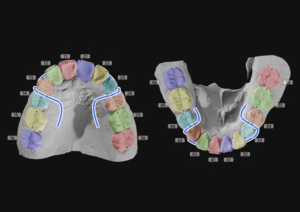
Our WBM-V2 connects with Riton Cloud and OrthoWireLab. Design data can be sent directly to the equipment, while its software uses AI-assisted functions to recognize model feature points and generate common appliance structures.
The OrthoWireLab also includes path-planning algorithms and 3D dynamic calculation for continuous, interference-free forming. For laboratories already working digitally, this connection can reduce manual handoffs between design and manufacturing.
- Production Management Becomes More Connected
Automation becomes more valuable when it extends beyond the bending operation itself. A production environment may involve multiple orders, designs, wire specifications, machines, and manufacturing stages. Managing those elements manually can create unnecessary coordination work.
The WBM-V2’s control system supports order tracking, remote transmission of design data, and remote equipment start and stop. Its digital workflow includes intelligent task scheduling and automatic sorting of processing tasks. The digital workflow also supports automatic matching of different wire-bending system specifications with corresponding equipment.
The workflow can extend from wire and base-plate design through wire bending, base printing, and assembly. That makes automation relevant not only to individual machine performance but also to how a laboratory organizes digital production.
When Is an Upgrade Justified?
An automated system makes the strongest operational case when repetitive wire forming is consuming substantial labor time, consistency is difficult to maintain manually, or digital designs are already part of the laboratory’s workflow.
Our view is that the upgrade should be evaluated against actual production constraints rather than automation for its own sake. Review order volume, operator workload, forming consistency, data-transfer requirements, and the degree of digital workflow integration before making the investment.
For laboratories seeking a wire bending machine supplier, those criteria also provide a practical framework for comparing equipment. The right solution should address the specific bottleneck that prompted the upgrade.
Ultimately, the five reasons are interconnected. More repeatable bending supports consistency; shorter cycles support throughput; reduced manual intervention changes labor allocation; direct digital connectivity reduces workflow friction; and centralized production management can improve coordination. At Riton, we focus on connecting these elements within an integrated orthodontic wire manufacturing workflow rather than treating automated bending as a standalone operation.